Author: Anaïs Moisy

Designer | Scientist | Dreamer

Jawbone experience


I wore a jawbone up bracelet for 22 days: 1 week during our holidays in Berlin and 2 typical weeks in Edinburgh.
I am not so interested in the results. One easy observation I can make on it (but it is not a surprise, as luckily I am aware when I exercise or not): I walked 4 times more in holidays and I am mostly seating working at my computer while I am in Edinburgh.

 
Screen Shot 2015-03-11 at 10.48.47

Screen Shot 2015-03-11 at 10.49.03
 
What I am interested in is my experience and relation to the bracelet. Something I regret is that I haven’t taken note of when I was uploading my data into the app. It would have been interesting to see the evolution visually and not only rely on my memory.
 
Untitled-3 copy4

The app is presented like this:

IMG_0444 IMG_0445
 
You can have the detail of your activity for a day, or the quality of your night. It gives you how much you woke up or the length of your light and deep sleep.
On the summary page you can navigate to see the different days and select the one you are interested in to get the details described above. Moreover, you get the overview of the day and night with some advices or suggestion for new goals (picture on the left).
I wanted to experience this new ‘quantified self’ way of living. My questions where: is it going to modify my behaviours (maybe I will start to do sport again… it is unlikely)? Is it going to make me realise something I am not aware of ? Am I going to be addicted to know how much I walk, and sleep? Is it going to be the first thing I do when I woke up in the morning ?
 
 
First the addicted effect: I didn’t get addicted. If I recall the times I uploaded the data it was approximately: the 3 first days 3 times: 1 in the morning, 1 in the afternoon, 1 at night; then for 3 following days it was around 2 times; the next week was only 1 time a day and for the final week it was every 2 or 3 days. One thing to mention is that in addition to manually plug the bracelet to your phone to upload the result, you also have to clic on a button at night and morning when you want to swap the bracelet between the night and day mode. The final week I completely forgot to do it. The result was I got some error on the Wednesday 11 at night.
The curiosity make you check at first to put number on something you already aware of (if you were walking or not, or if you had a terrible night). And because I started during holidays, it was fun to know how many km we were doing in a day. But it was the only advantage for me. It is something I could have done with a pedometer and which doesn’t require this technology.
We compared the result of the distance between a new iPhone which have the same functions and the jawbone app. It was quite similar, which means it might be accurate (to a certain extent).
For sleep it was interesting at first to see the different phases of light and deal sleep. However I have some doubt on the accuracy of the results. I knew that some night I need quite a lot of time to fall a sleep, but according to the app I needed only 20min. Is it because I was quite static ? Not sure how to explain it.
 
 
Second does it make a change: I didn’t change my behaviours. It is not because my phone is telling me that I am not walking enough that I will start changing radically the way I live my days. I know that it could be bad for my health to seat all day (with a bad posture in addition) but I feel ok in my body for now; I can still walk 18km in a day without feeling sore few day in raw like we did in Berlin. I believe that my body will warn me if I need a healthier life, and my phone is not the solution for making a change.

All of these analysis are only my voice. It is not because it didn’t work for me that it can not help other people. It is increasingly popular, it means people are interesting in it.
 
Quantified-self
The term “quantified self” was coined in 2007 by Gary Wolf and Kevin Kelly, editors of “Wired magazine”, who created the site of the same name. Formerly reserved for sportspeople, diabetics or people who needed to monitor their blood pressure, the quantified self movement has become more democratic in recent years with the miniaturisation of electronic chips and the wider availability of intelligent devices such as smartphones. The goals can be “to “achieve a better life balance”, improve health, sport training like a professional…
However, self tracking can go too far. Georges Conne, a GP working in Bussigny-près- Lausanne, believes that this practice could give rise to unnecessary anxiety. He set out his fears in a column published recently in the Revue médicale suisse. “Unless people are suffering from a chronic illness requiring constant monitoring, such as diabetes, the practice of continuous tracking tends to increase patient anxiety,” he said. “Users collect personal data and then compare it to a standard. Anything above or below the standard is considered to be pathological. But who sets the standard? This is where medical advice is necessary to provide a filter.”

A survey of 3,014 adults living in the United States asking questions on “ Tracking for Health” indicates that seven in ten U.S. adults track a health indicator for themselves or for a loved one. People living with chronic conditions are significantly more likely to track a health indicator or symptom.
19% of U.S. adults reporting no chronic conditions say they track health indicators or symptoms
40% of U.S. adults with 1 condition are trackers
62% of U.S. adults with 2+ conditions are trackers
There were significant differences between the 50% of trackers who record their notes in some organized way, such as on paper or using technology, and the 44% of trackers who keep track solely “in their heads.” We will note the differences in each section that follows. People with more serious health concerns take their tracking more seriously.
46% of trackers say that this activity has changed their overall approach to maintaining their health or the health of someone for whom they provide care.
40% of trackers say it has led them to ask a doctor new questions or to get a second opinion from another doctor.
34% of trackers say it has affected a decision about how to treat an illness or condition.
Tracking has had a more significant impact on people living with chronic conditions

Am sceptical on this new ‘mode’ for people without chronic condition. Is it really the future? It seems that it is what people want. Or is it big multinational company who convince people they need/want ? (see the good article Apple’s Big Plan To Make You Want Things You Don’t Need).

For my personal project, it makes me realise that create an app with will give numerical data about the state of the planet would not be efficient. It is already difficult to change habits when it is for yourself, it would be even harder to do it for something you are not connected with anymore. You might check a first and forget about it 5 minutes later. It make me realise why the data I put at the back of the cards did not work. A physical object displaying in a poetic way some data might have more impact than a graph.

The leaking hourglass

I started thinking about our survival needs, from what came the important question: why are we not more careful on what we do on the planet, when it is what offer us the possibility to live?

Our survival needs are:
– nutriment
– oxygen
– water
– appropriate atmospheric pressure

We can survive:
– 3 min without air
– 3 hours without a regulated body temperature
– 3 days without water
– 3 weeks without food

The one I am the most interested in is the water. Maybe because it is my favourite element to be in and my favourite drink 🙂
Our body is composed between 60% and 80% of water. It (water) provides the environment necessary for life.

A sandglass is meant to give the time like it is indefinite, but what if it was leaking ?

I am thinking to make one with water. The amount of water inside would be equivalent on the volume available on earth/per person, and would leak in accordance of the diminishing of the resource.

 
h-3393
 

Data to sound & New turntable

Python doing music

Tania asked her boyfriend Aldo to help us with transforming our raw sound into something more musical. He found a great music synthesizer made in python by a guy called Martin C. Doege
He used a 3D model file we gave him: .stl file to .wav (via importing raw data in Audacity).

This is the original sound file:


What he did is (quote him form his blog): “the basic idea was to read the wav file, get the data, which is an array of numbers with lots of precision. That particular wav file (the one Tania gave me), it ranges from -1 to 1, and it was 1519616 on length. So, the idea was to map those values, and the changed them to notes, and then create a synthesizer sound file from it. Of course there is more music science behind it, but me, being not a music scientist I fixed the octaves, and with that the time changed…”

It gives this file:


The code is this:
 
Screen Shot 2015-03-10 at 16.17.21
 
We also received the first of the 4 turntables we will use for our installation. It is working perfectly and we have now to find some speakers in order to make the installation working.
 

PlanetGuard

I conducted a quick study on the job of Lifeguard. As previously said, I know this job particularly well as it was my student job for 8 years. In the mind of people, it is easy you just spend your days waiting. It is true for the last part, you wait a lot but it is not easy. Your body is in pause, but you have to fight to not put your mind in pause too, as you have to constantly be alert to detect if someone need help; the noise is also very tiring. Moreover, most of the interventions are preventives. It is like ‘Minority report’ you alert or even punish before something happen, trying to visualise what could happen in the future, preventing potential accident to happen.

As the Lifeguard do, should we all keep an eye, not on people swimming, but on the planet and prevent disaster ? Could we all become PLANETguard. The question is how to get people to watch and prevent the disaster ?

First experimentation

What I have done so far is ask my college in France to answer 10 open questions, like I would have done in an interview, but by sending a form it allow me for a first stage to get more answer from more people, with taking little of their time instead of 1 hour. I managed to get 5 answers. The results are in french and anonymous.


ContactSheet-001

Screen Shot 2015-03-10 at 11.28.21


Results

The questions are around the way they invigilate the swimming pool, how they manage to stay focussed, if they choose to prevent or wait for a problem to happen, and how they detect that something bad could happen. Finally I ask if they needed a tool or an invention to help them to do a better job. In the answers I had, they insist a lot on the prevention, someone even say that it is a bit like being a voyeur. Concentration comes with experience because you can detect problem before they arrive, they develop a 6th sense. One person told me that first she use prevention but if the person doesn’t care she wait for the problem to happen so the public take consciousness of the risk. To do the job well they recommend to move, be in action, fight agains monotony, and prevention is the key word. The would suggest camera under the water, give a better education to the people, and a good one is create bionics ears to detect calls for help.

Conclusion

From the answers, I should find something to educate / create a detector of danger / an alert system / a way to see under the planet, listen to it more carefully / foster mobility.

Second experimentation


I ask them to attach a camera to the chair from where they work to film their face. I wanted to analyse the face and the method form another point of view (not my internal one). Thanks to Jean Michel and Simon for doing it. I got two video, from a quite swimming pool in my home town Le Mans. They could not instal it in one of the busy swimming pool for security and privacy policy purpose. I only have 2 persons, and you feel that there is no one to look after. At first I thought I would not be able tu use the videos at all. But After looking at it few times, even if there is not a lot of people to look after, they have their eyes almost constantly on the pool. They seems relax at first but when you zoom on the eyes you can detect the concentration. it should be like it for everyone towards the planet: live your life: be relax, but have constantly an eye on it, without even have consciousness of it.

From these reflection I made this little clip.


Time Flies

time flies


I finally made visual and analysis the results I got from the research I made with 27 participants with he cards TIME FLIES. Thanks a lot to you all.
The purpose was to get information on how people occupy their time nowadays, and questioned our habits and routines… I wanted to find out if there is still time for reflection, and where are these in-between moments.

I created these little cards where people are asked for 2 consecutive days to colours their time line, and where they the action. For each day they can propose an alternative day. Asking the question at the end of the day what I would have done differently.


IMG_0219


The back of the cards were made with data from the evolution of the planet. I wanted to see if quantitative information would have questioned the participant and if they would have make either a comment about it or if it would have influenced the results for the alternative day.

Moreover, I wanted to compare if the fact of asking an alternative day, influenced the second day.


Analysis of the results

– most people don’t have any moment when they do nothing. Also the action of reading appears in what they wish to do, but almost anyone find the time to read anymore, or they favour another activity.

– in the comments, some people pointed out that it was interesting to get the opportunity to reflect and think about what we actually do in our days and that is it hard to change bad habits. Someone said that it is difficult to track what we do, but also remember. We are so much in the flow of our day that we don’t even realise what we do.

– the fact of thinking of an alternative day doesn’t seem to affect the second day.

– the data I put at the back doesn’t seems to affect the alternative days, as I didn’t get any comment on that. To know if it has an effect or not, I should have give to half the participant a card with information on the back and to the other half a blank back. I could have compare both set of result and see if there is an impact. A smaller and more target study would have been necessary as well. With this amount of result: 19 categories, 2 days divided in 12 minutes + 2 preferred days divided the same way; it would be difficult to analyse the difference between 2 set of participants.

– what is considered as activities in a day is different from one participant to another. For some participants, the action of eating, sanitation, travel are not evoked; while some others tell precisely when they were on toilette or have sex. Few people had inactivity. We all have some time in a day where we do noting, but this study show that we don’t really realise it. Another possibility would be that we are ashamed to say it. I believe that these ‘in between’ moment are great, to escape, thinking or simply rest. However there is still the possibility that I am wrong and they didn’t miss to talk about this moment on the card, because there is no moment to do nothing nowadays.

– people with a job have more routine days than students. Is the fact to have commitment only for ourselves and not for an employer, would make us ‘students’ less well-behaved ? Do we need to get paid to have discipline ? Or maybe the routine dictated by company work is not equal to productivity, and a student can be as productive, or more productive than a worker without a routine ?

– I could divided the participant in 2 categories when looking on alternative days: half would like to do more shopping and leisure and the other half more sport or reading. It suggest that half of my sample would be more in a consumption way of living, while the other half would be more concerned by the mental and physical well being. I think it is quite representative of today’s society.


Conclusion

It is difficult to change the habits of people and intervene in there everyday life. If I want to make refection on our action on the ‘planet’ it is not on work time: the mind is not receptive, and working tasks are prioritised. Moreover, I want to keep the in-between moments, as I believe that they are important and already very little.
I found that the best place to foster reflection seems to be at home. It would allow me to infer a message on the everyday life, not something intrusive like the quantify self, but something more subtle: ‘it’ would be here to remember ‘something’ about the planet but also. ‘It’ would be ‘present-absent’ like a painting or a sculpture. It would seems passive but would be poetically active.

Design and experimentation of the 4 arms turntable

The goal is to create a turntable with 4 arms, allowing to listen to 4 tracks of a single vinyl at the same time.
Each vinyl will be the representation of an object. Each track will be the transposition of data from the object into sound.
The tracks will be representative of:
– the material of the object (molecule composition of all the materials composing the object)
– the size : volume, density, form, data extract from the 3D model
– memories: story from the owner
– use: movements, sound it masques, is it a static object, portable…
 
I already made a video concept of it for a previous concept


We made a try with 2 turntable, using the 2 arm on one. And it works, we get the 2 tracks at the same time


For the design of the installation I started to make some sketches and 3D drawings. They are the first attempts.
 

New proposals: Production vs Edison

Based on the research summerized in the article Research around the turntable I propose two new concepts (after the first one: The World as Turntables).

In Homage to Thomas Edison

Edison was a prolific inventor. He is particularly well know for the invention of the electric light and power utilities, sound recording, and motion pictures all established major new industries world- wide. Edison’s inventions contributed to mass communication and, in particular, telecommunications. Using this information that turntable and electric light have the same inventor, I propose an installation linking two topics of the gallery changing nation in the museum of Scotland : DAILY LIFE – HOME TECHNOLOGY and ENERGY – SCIENCE AND TECHNOLOGY.

The turntable would be transformed into generator, when it is playing, touching a special venial, it will generate light, using the rotation of the turntable to generate electricity or/and the contact of the needle onto the vinyl.


proposal 3

Production line/Linn

The turntable in the museum is a Linn Sondek LP12. Linn  is one of the stalwarts of the British hi-fi industry. Taking its name from a local park  in Glasgow, Linn was  founded in the early ’70s and started off with just one product – the legendary LP12 turntable. Since then the company has developed an impressively comprehensive product range.

I was thinking to recreate the production line of the turntable by generating sounds from each steps of the production, from raw material to finish product. The single harm could go from one turntable to another, picking the sound related to the action (we should figure it out how we generate the sound: which data ? record in the factory ? …).
The harm would reading the sound, then add the second one on top of it. Like record a sample then add one on top of each other on the same principle of a loop pedal (exemple here)

It could be a reflection of the factory process (linking the communication part to the industry part of the gallery).

It also play on the on the production line method of the construction a mass produce product and the brand of the turntable Linn.

Finally there is a reflection on the music procession as well. The evolution of music and the possibility that turntable offered to musicians: Turntablism, which is the art of manipulating sounds and creating music using direct- drive turntables and a DJ mixer: the record player becomes a musical instrument. DJ use turntable to mix and samples. This installation would also be a homage to this art.

proposal 2

Combination of both

Edison was one of the first inventors to apply the principles of mass production and large-scale teamwork to the process of invention, and because of that, he is often credited with the creation of the first industrial research laboratory. From this information we can easy imagine and justify that these 2 concept could become a single one.

Berlin Transmediale 2015

We spend with my master class of design informatics a week in Berlin attending the Transmediale festival. What do the futures of work, play and life look like through the black mirror of data? How will our quantified lives unfold? transmediale 2015 looks at how we make sense of a culture dependent on measurement and automation procedures, and how to act with autonomy within such a culture.

It has been a very inspiring week. I will share the notes I took during the festival as well as some projects which were the most inspiring for me or innovative.


This was our plan with Clément for the 3 days:

  • 1 opening ceremony
  • 1 concert @ Berghain
  • 1 screening
  • 5 conferences
  • 4 performances
  • 3 exhibitions


Notes and reflections


Keynote capture all_work
Judy Wacjcman
Puting life to work
Work is done in time
Capitalism: work in a periode of time = certain amout of money
Comercilisation of emotion
How we manage our time in today work with digital technilogy
Boudaries between work, personal life, sleep…
New technology promise to free our time ( do things simultaneously)
Technology changed the character of time
Synchronised activity  in unsynchronised society
Emails symbolic of work stress
Quality of life
Labour Technology and time


Play as a commons practical utopias and p2p futures
Ruth Catlow
Play Your Place – Creation of good life is the buisness of us all
Further field – Public space for exhibition
Platforn game good to think at Action and consequence
Make your game with your drawings
Make the world together – Play the web we want
Oposit to gamification
Back to the collective, is this really?
Ludic turn (used by neoliberal)
Open Source is a meritocracy, hacker is a benevolent dictator
Benefit still : fast non hierarchical production
PlayYourPlace : Game platform on Github
Gamification is a thin / dry layer over the world. Marketing tool
Stuck within templates stopped asking the right question
Higher potential, higher risk and reward to be be awarded by real world utopian games
When you play you leave/ are freed from pattern of behaviour
Free to act as you wish
 

Fascination for utopia – Utopian thinking
Alternative way of interaction – Game to make topic accessible
Art design and education – Novel senario even absurde
i am what i am
ykon game
Play act as aproach the world as if…. Reamigine
Have freedom to imagine how it could be different
It is not only possibility it is also danger when you propose alternative
Look for solutiom or provocation
Looking at solution can close debate
You can change your atitude
Ludification of culture: never before have people played as much as they do today
Partial utopia: realistic alternative possibility
Furtherfield
DIWO do it with others


Keynote Capture All_Life
Byung-Chul Han
What is transparency – Transparency positive meaning before
New parendim
Fredom freewill autonomy
Power of the rule of like “smart power” is that it doesn’t impose, force itself on the user
It pleases, creating dependence
It’s hard to identify because it “just happens”
 

DATAFIED RESEARCH: CAPTURE PEOPLE
Discovery of AdNauseam
As online advertising is becoming more automatic, universal and unsanctioned, AdNauseam works to complete the cycle by automating all ad-clicks universally and blindly on behalf of the target audience. Working in coordination with Ad Block Plus, AdNauseam quietly clicks every blocked ad, registering a visit on the ad networks databases. As the data gathered shows an omnivorous click-stream, user profiling, targeting and surveillance becomes futile.
 

Appropriate and Accelerate – Art Under Algorithmic Pressure

Jennifer Lyn Morone
Jennifer Lyn Morone is an American born natural person who incorporated her identity by founding Jennifer Lyn Morone™Inc in 2014 during her time as an MA student at the Royal College of Art. Since then Jennifer Lyn Morone’s mission is to establish the value of an individual in a data-driven economy and Late Capitalist society, while investigating and exposing issues of privacy, transparency, intellectual property, corporate governance, and the enabling political and legal systems.

0i0i00Video_stills


Jonas Lund (1984, Sweden) creates paintings, sculpture, photography and websites that incorporate data from his studies of art world trends and behaviour.
Very interesting talk when he question the way the art is valued.
For Curate This he use his curatorial rank algorithm to determine what works from the collection of multiples and editions of Galerie van Gelder would generate the biggest positive impact on his curatorial rank. Lund supplied Willers with detailed analysis on all the works in the collections and what influence they would have on his curatorial rank. Willers then consulted the list and made his final selection of works for the exhibition.


wallnoe-1


Another work he presented was Studio Practice. On his web site it is presented like that : he transformed the gallery into an art production line by hiring four assistants who will work full time during the gallery’s open hours throughout the run of his exhibition. Their task is to produce work inspired by the guidelines set out in a 300 page book that Lund created expressly for them. Once a work has been completed, it will be reviewed online by an advisory board consisting of artists, art advisors, gallerists and collectors. The board will assess the work so that Lund can better decide whether the work should be signed or destroyed. The entire process will be publicly accessible in the gallery space and on a dedicated website (studio-practice.biz). The website will include live footage of the gallery, assessments of the advisory board as well as Lund’s final decision and comments regarding specific works.


EXHIBITIONS

Stakhanov
Clément appeared every two lines on the Stakhanov installation… quite weird and scary.

Presentation Stakhanov is the BigData Oracle of the new era. In the era of Data, Information and Knowledge, Stakhanov is the expression of our new global data-religion. Stakhanov continuously harvests social networks for information and data, making connections, assumptions, correlations, using them to predict the future. Line-by-line, it emits its verdicts about what will be and that which won’t. This is the Word, coming from the Data-Above, in The Cloud. A playful neo-religious data-invasion of privacy, an exploration in false-hopes and in the ingenuity of contemporary determinism.


Erica Scourti – Body Scan
First I have been very impressed by her performance during the opening ceremony, then by her work in the exhibition space. I can’t really explained why I really like her work… I just found quite fascinating and very well executed. It must ask a lot of patience and hard work to perform like that.
 
Presentation A snapshot of mediated intimacy, Body Scan records through screenshots a process of photographing different parts of the artist’s body with an iphone similar image app that identifies visual information and links it to online data. At times assuming the instructive voice of a body scan meditation, the accompanying voiceover draws on the search results to convey relational uncertainties and sexual energies entangled with commodity descriptions. A game alone and between lovers turns skins into readable interfaces full of the potential for miscommunication, and signals connections between embodied, private experience and public, commercial data.


Silvio Lorusso & Sebastian Schmieg – Networked Optimization
Helping to realise how little we are actually reading, or in general what percent of information we memorise or assimilate. Simple great idea of data visualisation.


Presentation Networked Optimization is a series of three crowdsourced versions of popular self-help books. Each book contains the full text, which is however invisible, because it is set in white on a white background. The only text that remains readable consists of the so-called “popular highlights” – the passages that were underlined by many Kindle users – together with the amount of highlighters. Each time a passage is underlined, it is automatically stored in Amazon’s data centers.


Networked_Optimization_a01425_web_bunt


Time and Motion: Redefining Working Life 

Oliver Walker – One Euro
Stunning idea to represent inequality, labour, value…

Presentation One Euro is a six channel video installation, with each channel depicting one person working. Each video lasts as long as it takes the person depicted to earn one Euro. The films vary in length from well over an hour for low paid agricultural workers; to their slightly higher paid counterparts in industry; via those on middle income wages; down to one minute, and with one film little over a second long. The films do not offer a narrative, but rather quite detached observations of people at work. It is not intended as a didactic essay on wage inequality, though it invites reflection on these staggering inequalities, and this political position is ultimately not left ambiguous. Whilst we often encounter information about inequality presented through text or graphics, here time is employed, making direct comparison more difficult. Ultimately the people on the screens are simply taking part in their everyday lives, and we see six people on six screens, side by side.


Ellie Harrison – Timelines
Beautifull visual of our daily routine. Very inspiring.

Presentation For almost five years Ellie Harrison documented and recorded information about nearly every aspect of her daily routine as part of her artistic practice. These laborious, demanding and introverted processes grew ever more extreme until she devised the ultimate challenge in 2006 for Timelines – to attempt to document everything she did, 24 hours a day, for four weeks. The Timelines project was motivated by Ellie’s overwhelming feeling that she was ‘always at work’, it was to be an empirical study – monitoring exactly where all her time was going – to find out whether this was indeed true. What had seemed like a simple proposition quickly became an all-consuming ritual in which she was forced to take on the dual role of ‘observer’ and ‘observed’. On the first day she confessed that ‘It was horrible feeling so trapped – I couldn’t do anything without generating and accumulating data’, and so she rationalised the experiment by categorising her time into 17 possible activities such as ‘art practice’, ‘domestic work’ or ‘leisure’. Each day the data was transferred onto an expansive spreadsheet. By the end of the four weeks it contained 2,297 entries, which were then transposed into a series of 28 colour-coded timelines.

ellieharrison-publicationspread
 

Tuur Van Balen & Revital Cohen – 75 Watt
Intriguing at first, then beautiful and after reading the explanation it all made sense.


Presentation A product is designed especially to be made in China. The object’s only function is to choreograph a dance performed by the labourers manufacturing it. The work seeks to explore the nature of mass-manufacturing products on various scales; from the geo-political context of hyper-fragmented labour to the bio-political condition of the human body on the assembly line. Engineering logic has reduced the factory labourer to a man-machine, through scientific management of every single movement. By shifting the purpose of the labourer’s actions from the efficient production of objects to the performance of choreographed acts, mechanical movement is reinterpreted into dance. What is the value of this artefact that only exists to support the performance of its own creation? And as the product dictates the movement, does it become the subject, rendering the worker the object? The assembly/dance took place in Zhongshan, China between 10-19 March 2013 and resulted in 40 objects and a film documenting the choreography of their assembly.


Performances

 
The Pirate Cinema
It was great. A bit overwhelming in term of chaotic sounds but the idea is brilliant and well executed.

Presentation The hidden activity and geography of real-time peer-to-peer file sharing via BitTorrent is revealed in The Pirate Cinema, a live performance by Nicolas Maigret and Brendan Howell. In their monitoring room, omnipresent telecommunications surveillance gains a global face, as the artists plunder the core of restless activity online, revealing how visual media is consumed and disseminated across the globe. Each act of this live work produces an arbitrary mash-up of the BitTorrent files being exchanged, in real time, in a specific media category, including music, audio books, movies, porn, documentaries, video games and more. These fragmentary contents in transit are browsed by the artist, transforming BitTorrent network users (unknown to them) into contributors to the audio-visual composition that is The Pirate Cinema.

pirate-cinema_exhibition
 
Citation City
It was AMAZING. An incredible work of very clever references. The sound track mixing live was perfect and same full of references. I would watch it again , because I am sure that there is some great moment you miss when you look at it once. I recommended ++++.

Presentation: A world premiere of the new audovisual performance of renowned collage artist People Like Us (Vicki Bennett). The project is a further development of the artist’s database approach to cinema, deconstructing cinematic clichés and representations into unique associative and playful narratives. Citation City sources, collage and edits 300 major feature films where content is either filmed or set in London – creating a story within a story, of the film world, living its life, through extraordinary times of change, to see what happens when these multiple narratives are combined… what will the story tell us that one story alone could never tell? Inspired by The Arcades Project by Walter Benjamin, this audiovisual performance is created from 1000s of clippings of text and visual media, collaged using a system of “convolutes”, collated around subjects of key motifs, historical figures, social types, cultural objects from the time. By gathering and assembling such groups of similar yet unrelated, he revealed a hidden, magical encyclopaedia of affinities, a massive and labyrinthine architecture of a collective dream city. In the live performance a series of story lines (convolutes) sit side by side with a soundtrack sourced both from the movie content, as well as new sample compositions thematically related to the visual content. 

Robin Fox & Atom TM “Double Vision”
It was like seeing the sound in 3D infront of our eyes. Magical. The ceiling was transformed into a sky thanks to the laser and the smoke.

Interview of Robin Fox & Atom TM HERE

First thought for a new project

Initial project

Scope: empathy, encouraging not to be selfish/ egocentric
– borders between people
– fear of difference
– zone of comfort
– blind / ignorance of what is happening around you
Outcome: reflect on our place within our society, mankind and environment
– break physical  and psychological  borders
– open to others
– break the feeling of ultra-powerfulness : we can’t see it all

Next project: widening scope / look at another aspect

I push people to reflect on personal questions (borders in mind, or where a single persons  is allowed to go…) Now reflection on the fact we are part of a whole (Analogy with childhood/teenage hood when you gradually increase you awareness of the world around you)
– consequences of our actions/inaction/behaviour
– butterfly effect, long term consequences
– looking a bigger picture
– larger scale
– longer term

I came across this idea after looking at a new TED talk by Matthieu Ricard (see dedicated post and video)
He is saying that we are on “the edge of the planet” and this edge is the boundaries of the planet


IMG_0014


My context would be his video, to raise awareness of our right, duty and power as an individual to act for a greater good and a better future:

We are at a turning point / point of no return of what the earth can provide
– We have a choice and duty to educate ourselves to act and behave in a more sustainable manner.
– Encouraging people to feel the harmony of our ideal sustainable relationship with earth and the disharmony of our current relationship with it.
– Break the borders we constructed between us and the planet

Proposal

Create an instillation of turntables representing the different continents, one turntable=one continent.  On each a vinyl playing instrument(s) symbol of this continent. They all turn at different speed: speed = energy consumption of the continent (if we were all living like we do in Europe, we would need 2.5 planets to sustain, it would be worth in US… so for us the speed  will be x2.5). Then you would have cursor to answer simple question to calculate how many planet we would need if the rest of the world population was living like ourself. It would modify the speed of these disc. The goal would be to try to make the planet be in harmony (all the disc turning at the same speed to hear the music). 

Tutorial notes

Should look at

  • Sahra Sharma / re-calibration
  • nuclear clock
  • Tom Schoflieldart.com / neurotic armagedon indicator
  • entretags – timebots – family clock
  • Miyajima tatsuo – work with time
  • Sophie Calle – work with memories

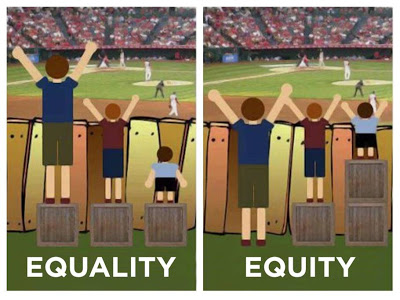
The first proposal might be too consensual. We all will never have the same right, same way of living. Do we want a homogene society, like we all are clones ? But in the same time it is not right that some have the ability to consume in 1 hour what other will in a month or more ? How can we find a balance between equality (the state of being equal, especially in status, rights, or opportunities) and equity (the quality of being fair and impartial: equity of treatment.)

equity

Equity, as we have seen, involves trying to understand and give people what they need to enjoy full, healthy lives.  Equality, in contrast, aims to ensure that everyone gets the same things in order to enjoy full, healthy lives. Like equity, equality aims to promote fairness and justice, but it can only work if everyone starts from the same place and needs the same things.

It is worth looking at this video of Hans Rosling about energy consumption and the inequality in the world.

We all live with different temporality as well.


Is fast wrong ? (slow food ≠ fast food)

harmony is difficult to define – it is not only fast and slow

Time and territory
When you look linear you miss direction and possibilities
Always in a narrative structure
How to find synchronicity
Try to find a moment where it is possible to detect synchronicity – can be very brief – loss of a moment = tension

I should look at some granularity – detail – personal detail – build a personal reflection

Think about the setting of my research:

  • empirical knowledge
  • interrogate the system
  • give to an test group something to study them
  • think about ethic
  • provocation ?

Other ideas after the tutorial

  • IMG_0193IMG_0195make a record with our own data -> global identification
  • 1 needle become a person – multiple needle on the same record how to find equity to make harmony ?
  • Cut a record to create our own (how a record is made) maybe it is one circle