Category: Classes

Time Flies

time flies


I finally made visual and analysis the results I got from the research I made with 27 participants with he cards TIME FLIES. Thanks a lot to you all.
The purpose was to get information on how people occupy their time nowadays, and questioned our habits and routines… I wanted to find out if there is still time for reflection, and where are these in-between moments.

I created these little cards where people are asked for 2 consecutive days to colours their time line, and where they the action. For each day they can propose an alternative day. Asking the question at the end of the day what I would have done differently.


IMG_0219


The back of the cards were made with data from the evolution of the planet. I wanted to see if quantitative information would have questioned the participant and if they would have make either a comment about it or if it would have influenced the results for the alternative day.

Moreover, I wanted to compare if the fact of asking an alternative day, influenced the second day.


Analysis of the results

– most people don’t have any moment when they do nothing. Also the action of reading appears in what they wish to do, but almost anyone find the time to read anymore, or they favour another activity.

– in the comments, some people pointed out that it was interesting to get the opportunity to reflect and think about what we actually do in our days and that is it hard to change bad habits. Someone said that it is difficult to track what we do, but also remember. We are so much in the flow of our day that we don’t even realise what we do.

– the fact of thinking of an alternative day doesn’t seem to affect the second day.

– the data I put at the back doesn’t seems to affect the alternative days, as I didn’t get any comment on that. To know if it has an effect or not, I should have give to half the participant a card with information on the back and to the other half a blank back. I could have compare both set of result and see if there is an impact. A smaller and more target study would have been necessary as well. With this amount of result: 19 categories, 2 days divided in 12 minutes + 2 preferred days divided the same way; it would be difficult to analyse the difference between 2 set of participants.

– what is considered as activities in a day is different from one participant to another. For some participants, the action of eating, sanitation, travel are not evoked; while some others tell precisely when they were on toilette or have sex. Few people had inactivity. We all have some time in a day where we do noting, but this study show that we don’t really realise it. Another possibility would be that we are ashamed to say it. I believe that these ‘in between’ moment are great, to escape, thinking or simply rest. However there is still the possibility that I am wrong and they didn’t miss to talk about this moment on the card, because there is no moment to do nothing nowadays.

– people with a job have more routine days than students. Is the fact to have commitment only for ourselves and not for an employer, would make us ‘students’ less well-behaved ? Do we need to get paid to have discipline ? Or maybe the routine dictated by company work is not equal to productivity, and a student can be as productive, or more productive than a worker without a routine ?

– I could divided the participant in 2 categories when looking on alternative days: half would like to do more shopping and leisure and the other half more sport or reading. It suggest that half of my sample would be more in a consumption way of living, while the other half would be more concerned by the mental and physical well being. I think it is quite representative of today’s society.


Conclusion

It is difficult to change the habits of people and intervene in there everyday life. If I want to make refection on our action on the ‘planet’ it is not on work time: the mind is not receptive, and working tasks are prioritised. Moreover, I want to keep the in-between moments, as I believe that they are important and already very little.
I found that the best place to foster reflection seems to be at home. It would allow me to infer a message on the everyday life, not something intrusive like the quantify self, but something more subtle: ‘it’ would be here to remember ‘something’ about the planet but also. ‘It’ would be ‘present-absent’ like a painting or a sculpture. It would seems passive but would be poetically active.

Design and experimentation of the 4 arms turntable

The goal is to create a turntable with 4 arms, allowing to listen to 4 tracks of a single vinyl at the same time.
Each vinyl will be the representation of an object. Each track will be the transposition of data from the object into sound.
The tracks will be representative of:
– the material of the object (molecule composition of all the materials composing the object)
– the size : volume, density, form, data extract from the 3D model
– memories: story from the owner
– use: movements, sound it masques, is it a static object, portable…
 
I already made a video concept of it for a previous concept


We made a try with 2 turntable, using the 2 arm on one. And it works, we get the 2 tracks at the same time


For the design of the installation I started to make some sketches and 3D drawings. They are the first attempts.
 

New proposals: Production vs Edison

Based on the research summerized in the article Research around the turntable I propose two new concepts (after the first one: The World as Turntables).

In Homage to Thomas Edison

Edison was a prolific inventor. He is particularly well know for the invention of the electric light and power utilities, sound recording, and motion pictures all established major new industries world- wide. Edison’s inventions contributed to mass communication and, in particular, telecommunications. Using this information that turntable and electric light have the same inventor, I propose an installation linking two topics of the gallery changing nation in the museum of Scotland : DAILY LIFE – HOME TECHNOLOGY and ENERGY – SCIENCE AND TECHNOLOGY.

The turntable would be transformed into generator, when it is playing, touching a special venial, it will generate light, using the rotation of the turntable to generate electricity or/and the contact of the needle onto the vinyl.


proposal 3

Production line/Linn

The turntable in the museum is a Linn Sondek LP12. Linn  is one of the stalwarts of the British hi-fi industry. Taking its name from a local park  in Glasgow, Linn was  founded in the early ’70s and started off with just one product – the legendary LP12 turntable. Since then the company has developed an impressively comprehensive product range.

I was thinking to recreate the production line of the turntable by generating sounds from each steps of the production, from raw material to finish product. The single harm could go from one turntable to another, picking the sound related to the action (we should figure it out how we generate the sound: which data ? record in the factory ? …).
The harm would reading the sound, then add the second one on top of it. Like record a sample then add one on top of each other on the same principle of a loop pedal (exemple here)

It could be a reflection of the factory process (linking the communication part to the industry part of the gallery).

It also play on the on the production line method of the construction a mass produce product and the brand of the turntable Linn.

Finally there is a reflection on the music procession as well. The evolution of music and the possibility that turntable offered to musicians: Turntablism, which is the art of manipulating sounds and creating music using direct- drive turntables and a DJ mixer: the record player becomes a musical instrument. DJ use turntable to mix and samples. This installation would also be a homage to this art.

proposal 2

Combination of both

Edison was one of the first inventors to apply the principles of mass production and large-scale teamwork to the process of invention, and because of that, he is often credited with the creation of the first industrial research laboratory. From this information we can easy imagine and justify that these 2 concept could become a single one.

First thought for a new project

Initial project

Scope: empathy, encouraging not to be selfish/ egocentric
– borders between people
– fear of difference
– zone of comfort
– blind / ignorance of what is happening around you
Outcome: reflect on our place within our society, mankind and environment
– break physical  and psychological  borders
– open to others
– break the feeling of ultra-powerfulness : we can’t see it all

Next project: widening scope / look at another aspect

I push people to reflect on personal questions (borders in mind, or where a single persons  is allowed to go…) Now reflection on the fact we are part of a whole (Analogy with childhood/teenage hood when you gradually increase you awareness of the world around you)
– consequences of our actions/inaction/behaviour
– butterfly effect, long term consequences
– looking a bigger picture
– larger scale
– longer term

I came across this idea after looking at a new TED talk by Matthieu Ricard (see dedicated post and video)
He is saying that we are on “the edge of the planet” and this edge is the boundaries of the planet


IMG_0014


My context would be his video, to raise awareness of our right, duty and power as an individual to act for a greater good and a better future:

We are at a turning point / point of no return of what the earth can provide
– We have a choice and duty to educate ourselves to act and behave in a more sustainable manner.
– Encouraging people to feel the harmony of our ideal sustainable relationship with earth and the disharmony of our current relationship with it.
– Break the borders we constructed between us and the planet

Proposal

Create an instillation of turntables representing the different continents, one turntable=one continent.  On each a vinyl playing instrument(s) symbol of this continent. They all turn at different speed: speed = energy consumption of the continent (if we were all living like we do in Europe, we would need 2.5 planets to sustain, it would be worth in US… so for us the speed  will be x2.5). Then you would have cursor to answer simple question to calculate how many planet we would need if the rest of the world population was living like ourself. It would modify the speed of these disc. The goal would be to try to make the planet be in harmony (all the disc turning at the same speed to hear the music). 

Tutorial notes

Should look at

  • Sahra Sharma / re-calibration
  • nuclear clock
  • Tom Schoflieldart.com / neurotic armagedon indicator
  • entretags – timebots – family clock
  • Miyajima tatsuo – work with time
  • Sophie Calle – work with memories

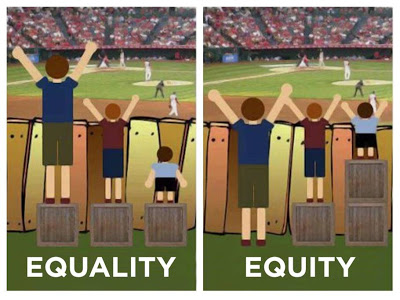
The first proposal might be too consensual. We all will never have the same right, same way of living. Do we want a homogene society, like we all are clones ? But in the same time it is not right that some have the ability to consume in 1 hour what other will in a month or more ? How can we find a balance between equality (the state of being equal, especially in status, rights, or opportunities) and equity (the quality of being fair and impartial: equity of treatment.)

equity

Equity, as we have seen, involves trying to understand and give people what they need to enjoy full, healthy lives.  Equality, in contrast, aims to ensure that everyone gets the same things in order to enjoy full, healthy lives. Like equity, equality aims to promote fairness and justice, but it can only work if everyone starts from the same place and needs the same things.

It is worth looking at this video of Hans Rosling about energy consumption and the inequality in the world.

We all live with different temporality as well.


Is fast wrong ? (slow food ≠ fast food)

harmony is difficult to define – it is not only fast and slow

Time and territory
When you look linear you miss direction and possibilities
Always in a narrative structure
How to find synchronicity
Try to find a moment where it is possible to detect synchronicity – can be very brief – loss of a moment = tension

I should look at some granularity – detail – personal detail – build a personal reflection

Think about the setting of my research:

  • empirical knowledge
  • interrogate the system
  • give to an test group something to study them
  • think about ethic
  • provocation ?

Other ideas after the tutorial

  • IMG_0193IMG_0195make a record with our own data -> global identification
  • 1 needle become a person – multiple needle on the same record how to find equity to make harmony ?
  • Cut a record to create our own (how a record is made) maybe it is one circle

My Map app

I created a new app called Mymap,  working on the concept to expend our territories and encourage to reflect on all the place we will have to discover in our life, as well as the one we will never see.

De Certeau argues that the act of walking selects and fragments the space traversed; it skips over links and whole parts that is omits. Moreover it can “be traced on city maps in such a way as to transcribe their paths and their trajectories. But these thick or thin curves only refer, like words, to the absence of what has passed by. A spacial order organises an ensemble of possibilities and interdictions, then the walker actualises some of these possibilities. In that way, he makes them exists as well as emerge.” [3]. It is what the app is doing: revealing the choices taken, the places visited or the path used, while the rest is hidden behind a white layer.

This is the mockup of my idea.

In my head it was quite a simple idea (coming from a person who don’t have any experience in coding yet) but in application it has been quite difficult and several iteration of the app had been necessary.

First I thought it would have been possible to make a reverse heat map: instead of having colours appearing on a layer on top of the map, it would make transparent the white layer. In practice what was possible is to draw a white layer on google maps by giving the points clockwise then removing polygons from this layer by giving the point anticlockwise. It created a lot of different issues: closing the route every time we created a new point: drawing the territory and not the route; superposed polygons resulting on re-masking the map…


The solution came up with the discovery of hulljs. Using a complex algorithm, it draws around the GPS points the route.

The app uses phone gap, a free and open source framework that allows you to create mobile apps using standardized web APIs for web platforms as well as mobile app with the same code. The language is Java Script. To store the routs (even is it not possible yet with the current version) HTML5 Local Storage will be use. Google maps API, Cordova plugin geolocation and the GPS of the phone are used as well.

I am already thinking about a future version of the app. I would like to make the map appearing in different shade of colours: for example the area you use all the time (’your territory’: going to work and back home for example) would be tinted in red, whereas the one you visited only once would be blue. it would allow a better understanding of the territory.

For complementary informations about the app (interface, calculus of the opacity), or more references have a look to the slides of my presentation and my research.

Revealing map (project proposal)

For this idea I also looked into the concepts of ‘creating your own border’ and ‘staying in your confort zone’, however, this time on ow to expend our territories and encourage to reflect on all the place we will have to discover in our life.

For that, I want to create a mobile app: it will be a white page when you start using it for the first time, then the map will reveal itself when you went somewhere physically.
I tried to make a visualisation of my idea in this short animation:

In my head it is quite a simple idea (coming from a person who don’t have any experience in coding yet 🙂 but we already told me that it is not as simple and I am worked I will not be able to make it on time for the 13th of december.
One way I think it might be possible is to make a reverse heat map: instead of having colours appearing on a layer on top of the map, it would make transparent the white layer.

The second stage of this project (depending how difficult it is to do the ‘simple’ idea), would be to make the map appearing in different shade of colours: for exemple the area you use all the time (’your territory’: going to work and back home for example) would be tinted in red, whereas the one you visited only once would be blue.

Invisible borders (project proposal)

For this idea I looked into the concepts of ‘creating your own border’ and ‘staying in your confort zone’, resulting to refuse to see in the other side of the road how people are living or even your closest neighbour ?

This observation started with the living lab project, where the two cycle paths going through Inverleith divide the neighbourhood into three different parts. This division coincides with the level of deprivation of the area, resulting in the path acting like a border within the community (see picture bellow). The journalist Anna Minton, claims that divisions in the cities are a key factor behind rising fear of crime and that the link between security and discrimination is most distinct at the extremes of ‘the social spectrum’, in very wealthy or very deprived areas. (2009, pp. 139-140 – Minton, A. (2009). Ground control. London: Penguin Group).


map copy


My feeling is that it is very easy to stay on a routine, ‘bury ours head in the sand’. It allows us to not called into question our behaviours and the impact of our actions in the society.
I believe that developing empathie, be open to others would help to create a better word. Experience, relate and understand others could help to be more open on the world surrounding us (on different scale) and try to ‘be in the shoes of someone else’. In a sense brake the borders we create.
That is why I had this idea to visualise the invisible borders within the city. Where are these streets which divide a ‘healthy’ neighbourhood to a ‘deprive’ one. How can you make people aware of these ‘invisible’ borders ? And by visualising them, could it help to awake about these disparities. Also, are people from one side of the road go to the other side or are they staying within their territory ?


borders edinburgh3
Screen Shot 2014-11-09 at 18.16.41
borders edinburgh2
borders edinburgh

I fist superposed the deprived scale map of Edinburgh on a satellite screen shot of the same territory. Then I traced in top, the road which separated two area with very different colours (a healthy area to a more deprive one).

It gives a different vision of the town. When you see the maps with the colours, you see the territories. When you only have the lines, to is about seeing the borders, and make reflect on the fact to ‘cross borders’, ‘walk in the territory of someone else’, ‘being curious of what is happening in the other side of the road’.

The final step was to convert these lines into ‘cloud’ or smoke, in order to make the borders visible but also fog and mist blur boundaries.

I made an image, trying to represent how it would look like.

borders-cloud-edinburgh1
smoke border
borders-cloud-edinburgh4

Looking @ ‘to be disconnected’

On my last post about the different topic I was looking I developed the one on borders.

Since few days I was looking at ‘to be disconnected’ in relation with happiness (the border theme also have a connection with happiness in the way I see it). I looked at the fact that when you work you are expected to answer an email promptly, or the time spending on social media in comparaison with ‘human’ (see this post).

On this topic I am interested in making the ‘invisible’, ‘visible’ (same ideas with the borders, I guess happiness and make the invisible visible are the commun aspect in both cases). Visualise all the data surrounding us all the time.

I am asquint the question: is there a correlation with being more connected? If you are in an environment with less radiation would you spend less time on your mobile?

For that I would like to measure:

• the level of radiation corresponding with location and to see if the person is more connected when there is more waves around (link GPS tracking and, data transfert and level of radiation).

• how much data transferred on a location (link GPS tracking and data transfert) and superpose with the map of coverage

• the number of word exchange with a real person in comparaison with number of word with social media (or time speeding corresponding verbally and on social media)

I guess it is maybe less interesting than the ‘border’ theme, as a lot of people are looking at the subject currently with these app helping to disconnect: FreedomI Off YouAntisocialForest or the wall paper which block radiations, and the WiFi cold spot.

I read that problems linked up with hyper connectivity are more a society issues (we use technology to respond to what is expected from us… ) and not a technical issue. Create more technology to not use technology seems not the right things to do, it is “the cat biting its own tail”.

I don’t think I can come with anything to change today society, because it means to solve a question of hierarchy (have the power, to be disconnected against society expect me to be connected all the time), also job organisation and planification, and  finally todays life style (teenagers hyper connected…).

ARTICLES

How Technology Can Help Work/Life Balance

La surconnexion est une question sociale, il est temps de s’en préoccuper

My thoughts

1016911_10203715108539606_3477322045463451090_n

Please give me your feedback on my ideas, and if you have any thoughts how I could develop them or in which direction I should go. Any comments are welcome. (see the pages with the mind map My thoughts)


The different themes I am looking at for the moment are:

BORDERS

on 2 different aspects: 
– inequality between people: because you are born in x or y country you can’t move freely (visa, border…) Why do I have some right than other people doesn’t have? How this is right ? Also, by doing that, is not increasing the desire to see what is forbiden? When you are not allow to do something you might try harder to make it possible.
– creating your own border by staying in your confort zone. It can result to refuse to see in the other side of the road how people are living or even your neighbour ? and I am not talking (yet) about situations in other country or continent, where it can be so far from the reference framework that it is difficult to identify to the situation or living condition.
My feeling is that it is very easy to stay on a routine, ‘bury ours head in the sand’. It allows us to not called into question our behaviours and the impact of our actions in the society.
Is developing empathie, be open to others would help to create a better word ? Experience, relate and understand others could help to be more open on the world surrounding us (on different scale) and try to ‘be in the shoes of someone else’. In a sense brake the borders we create.

DISCONNECT

To experience, relate, understand others, and reconnect with the self, I believe that it is important to be able to ‘disconnect’: from the technology, from the consumer society, from ‘always more’ and ‘always faster’.

EQUALITY

I am a bit obsess with this idea that we are all human, all made of 70% of water, all the same in a way. In contrast there is this huge inequality on the planet where world’s richest 1% own 40% of the world’s wealth. it is related with the first idea developed in ‘border’.
Maybe equality between people could maybe take place in the ‘between’ places, passage, connections, non spaces.

HAPPINESS

This is the big question: How to have a good life? Is happiness living well and doing well? Should it be our goal in life and how to get there? Yet, my position on these questions is that to have a good life you should act in coherence with the values you are believing in. You should go out of the confort zone to live new experiences, and learn from it what is essential for you and bring something positive out of it. It can be as simple as coming back from work by another route, try to observe the word with open mind and a sense of detail…