Author: Anaïs Moisy

Designer | Scientist | Dreamer

Shanghai, Disneyland , Longxu Mountain, Beijing, Great Wall of China

A selection of pictures from our latest trip in China.
I was still teaching Interior Design in Shanghai SCF – Dongua University. I am proud and would like to congratulate the fourth years students who are currently exhibiting their final year project for the FIRST-EVER SCF Graduate Exhibition 2018.

During the week-ends we had the chance to be there for the Lantern Festival, visited Disneyland Shanghai, went for a hiking trip with Hiking Lovers to the Longxu Mountain (very hard but worth it, it was stunning) and finally went for 3 days in Beijing and hiked on the Great wall (I would recommend anyone who want to do it to contact John – Here is Beijing . He is great and you will experience the wall by your own).


Romania, 2017

I spent 2 weeks in Timisoara, Romania in December, following Clément on a business trip.
I spent my days walking around the city center, taking pictures, drawing and drinking tea in Libraria Carturesti – strada Mercy.
The buildings in ‘Timi’ are fascinating by their colours and the fact the you can observe the time passing on them. During the weekends we went to Băile Herculane, Arad and Hunedoara.


The spa town of Băile Herculane has a long history of human habitation, inhabited since the Paleolithic era. Legend has it that the weary Hercules stopped in the valley to bathe and rest. Unearthed stone carvings show that visiting Roman aristocrats turned the town into a Roman leisure center. In modern times, the spa town has been visited for its supposedly natural healing properties: hot springs with sulfur, chlorine, sodium, calcium, magnesium and other minerals, as well as negatively ionized air. Before World War II, when the first modern hotel was built (i.e. H Cerna, 1930) it remained a popular destination with Western Europeans. During the Communist rule, mass tourism facilities were built, such as the 8- to 12-storied concrete hotels. Nowadays, the old spa buildings are abandoned, almost demolished ; the Austrian Imperial Baths building is ruined as well as the bridges over the Cerna river. Almost everything is in bad shape. It has the feel of a ‘ghost resort’. We managed to go inside the ‘Spa’ and it was both heartbreaking and fascinating. It must have been a very beautiful and relaxing place in the past. It made us realised how fast buildings and places can loose their hour of glory: even after being at the top for centuries it took only a decade to crumbled. At the same time it is very beautiful and a paradise for photographer: we spent at least two hours taking pictures and imagining how it was just few years back. You can read a good testimony in Vice about how the town is ‘Crumbling’ illustrated by beautiful pictures HERE.


The following week end we went to Hunedoara to see the Gothic-Renaissance Corvin Castle, also known as Hunyadi Castle or Hunedoara Castle. It is one of the largest castles in Europe and figures in a list of the seven wonders of Romania.
The legend said that it was the place where Vlad III of Wallachia (commonly known as Vlad the Impaler) was held prisoner by John Hunyadi, Hungary’s military leader and regent during the King’s minority, for 7 years after Vlad was deposed in 1462. Later, Vlad III entered a political alliance with John Hunyadi, although the latter was responsible for the execution of his father, Vlad II Dracul. Because of these links, the Hunedora Castle is sometimes mentioned as a source of inspiration for Bram Stoker’s Castle Dracula (from Wikipedia).


Another interesting discovery were the ‘Gypsies houses’ outside the city center of Timi. They are empty and barricaded castle like house, built by families of Gypsies, where they will use when they have families meetings such as weddings. They were for me really fascinating by their size, the mystery around them and the stories they could tell about their owners. Some beautiful shot of the interior of Houses (probably not the ones I photographed) HERE.


Shanghai for the love of Art, Teaching & Food

I am just back from Shanghai, where I had the pleasure and honor to teach Interior Design for 5 weeks at Donghua University representing Edinburgh University. The students have a lot to teach us all over here about passion, hard work and positivity.

It was 5 amazing weeks with my great colleagues and mon amoureux. In our free time we visited lots of galleries (list bellow of some of the best exhibitions I have seen), spend a day walking and riding in Hangzhou around the west Lake and we went for a week end in the mountains. We stayed in xia yan bei village (下岩贝村), hiked 19 peaks (穿岩十九峰), the Hanfei river ( 韩妃江)  and dao tuo xue (倒脱靴). And of course had some amazing food: hot pot, dumplings, wonton soups, noodles, Chinese crepes, vegan dishes…

I am starting to learn basic Chinese to prepare our next trip in March, looking forward to it.

  • chi K11 .com/.cn
    The work exhibited is digital / conceptual art. What we found most interesting for your practice is the building in itself.
  • MOCA Shanghai Apple+
    The exhibition highlights Japanese designer Ken Miki’s four decades of practice as well as his unique approach to design thinking and education, summarized in what he promotes as “Learning to Design, Designing to Learn”.
  • Rockbund Art MuseumHugo Boss Asia Art 2017
    High-profile award that honors emerging contemporary artists in the early stages of their artistic creation and exhibition practices.
  • Long Museum West Bund Antony Gormley
    The first major presentation of Antony Gormley’s work in China. At its core is Critical Mass II (1995) an installation of 60 life-size cast iron body forms.
  • Power station of Art Balkrishna Doshi, Shigeru Ban & Li Shan
    Shigeru Ban : What is the architectural content to be presented possibly only by exhibitions? The first half of the Exhibition will introduce the disaster relief projects across the world, & the second half of the Exhibition will introduce the projects in progress and the projects in China.
    Li Shan : he gave up his decades-long familiarity with painting, and turned his artistic thinking to topics that are related with bio-science. He claimed to be creating on a canvas once reserved only for the God, and created a new artistic discipline: BioArt.
    Balkrishna Doshi: Celebrating Habitat-The Real, the Virtual & the Imaginary. The exhibition showcases more than thirty pieces of the Indian architect’s notable works, including personal and public housing, community projects, educational institution, urban planning and furniture design.
  • Modern Art Museum Hello, My Name is Paul Smith
    Touring exhibition showcasing the fashion designer’s journey in building his company, as well as his stylistic tastes and eye for design.
  • Shanghai Minsheng Art Museum – Sonsara by Céleste Boursier-Mougenot
    “It is a project of imagination and contemplation, containing the reflection of the symbiosis and a control system for human and nature. The two issues that the exhibition wants to discuss, “how humans co-exist with the artificial nature” and “building an ecology, imaging the world after human”, constitute the two sides of the non-zero-sum game between human and non-human beings.”
  • Dialogue In The Dark
    Very exciting life-changing experiences where visitors are guided by blind guides in absolute darkness. You get a chance to experience space and daily environments of life without your sight. Daily routines become exciting and a reversal of role is created where sighted become blind and Blind become sighted. It was a life changing experience. 


Design Informatics Pavilion Facelift

Pavilion part of the Edinburgh Art Festival and the Fringe with the Future Play Festival.
Freelance for Design Informatics
Edinburgh, Scotland 2017
 
In 2016, The Design Informatics Pavilion was designed by Biomorphis, an Edinburgh-based architecture practice led by Pierre Forissier. Interested in how digital technology can be efficiently used to design an affordable modular structure, Biomorphis developed an algorithm to test and generate different cellular divisions to form a self supporting lightweight building envelope. For this 2017 edition I have been employed to give it a facelift, inspired by the 70 years anniversary of the Edinburgh Festivals starting from the launch of the first festivals in 1947 to 2017,  by the Design Informatics research topics and data from Edinburgh.
 

Pictures of the Pavilion by YUXI LIU

 
The graphs painted on the pavilion give the local context in which the festivals and Design informatics are taking place: the top line graph represents rainfall in Edinburgh in August in 5 year periods between 1947-2017. The bottom of the pavilion represents the elevations of Edinburgh during a walk through the cities most popular venues so starting on George Street and going to the Castle, the Meadows, The pleasance etc.

Then, the idea was to situate the history of the festivals in an international context, represented by technological breakthrough: each panel of the pavilion represents 5 years, creating a time line where icons (vinyls on acrylic) representing carefully chosen innovations, as well as some of Edinburgh festivals. Moreover, it established a link to Design Informatics, where students are trained and researcher worked on developing tomorrow innovations.

The pavilion become a time travel vessel: the outside is displaying the past of innovations, leading to the inside with the exhibition where you can imagine what the future might look like.

To realise this project, I worked in collaboration with Sigrid Schmeisser, to designed the icons. She realised the exhibition graphics, panels and brochure.
 

Dominoes

More informations in the report produced along the process.

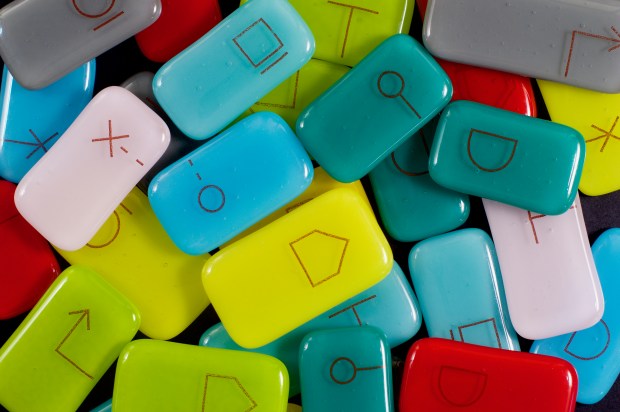
The Dominoes have been designed as a concept of a tangible interface for biologists to sketch DNA constructs. The interface consists of a series of pieces representing different DNA parts, using Synthetic Biology Open Language (SBOL).
By manipulating these pieces and snapping them together biologists can sketch DNA sequences. Then, the aim of this project would be to be able be transferred into Genetic Constructor (Autodesk CAD tool for DNA design) to insert the sequences into the sketch blocks and test the validity of their design.
It could then be send to be assembled by Edinburgh Genome Foundry (EGF), a facility at the University of Edinburgh that offers a unique robotic platform to synthesise DNA.


I have conducted a series of interview with biologist to determine what are the needs: how do they currently design DNA, how they would use them, where, when, what symbols or shape they are using most, do they need different kit depending the organism they are working with (yeast, mammalian cells, plants…) …
It also allowed me to discuss their projects to determine what could be potential future needs. I am currently in the process of designing the fist set of prototype to be tested in different labs at the University of Edinburgh.


In addition, during these interviews, we discussed how they would communicate the DNA design process to the general public: how to keep the process simple but accurate and what could be an interesting interaction to understand the principles of synthetic biology. It resulted in another project ‘Tales of Synthetic Biology’ presented Here.

From these interviews I have designed a kit of general blocs and 3 different options for the EMMA kit.

Design – general blocs
  • Use of 5 different colours for the coding sequence (promoter – CDS – terminator) to visualise 1 transcription unit. It will be useful when one transcription unit is will be to be express in the bacteria for the duplication (antibiotic resistance for example) and others will be expressed in the plant/yeast…
  • Blank pieces with directional arrow for projects where the direction is crucial at the early design stage.
  • Larger pieces for Transcription Unit (containing promoter – CDS – terminator) for high level sketch.
  • Small pieces for localisation signal, tag… to annotate some aspect inside a block
  • Two different proposals to visualise the strength of a promoter.
  • Two special set to design sequences for Golden Gate of Gibson assembly, in-order to determine the ending and connecting sequence of the blocks.
  • Each type of block is done with a speci c colour + a symbol to give the maximum visual markers, helping to design a sequence.
Design – EMMA kit

One kit where the colours correspond to type of the blocks, one where they correspond to position of the blocks and finally to the type of the blocks and they are numbered for the position.